AI/ML Competence Report
Sample MCQ Report
8 October 2025
Abstract
Understanding how well large language models (LLMs) can address the tasks we set students is a critical input into our decisions about what tasks to include in course, how those tasks are administered and what guidance acompanies them.1 AI Competence with Tasks Analysis Report
Our app tests the competence of different AI/ML models with the questions you supplied.
We tested 15 questions against 6 different LLMs. The LLMs returned 90 usable results, from a total of 90 tests attempted (i.e., the LLMs failed to return a useable response in 0 cases).
There are key insights to develop from the data:
- How reliable are the different models at producing machine readable responses?
- How competent are different LLMs for the types of tasks tested? and
- Which are the questions that pose the least and most challenge for the models?
1.1 Model Reliability for MCQs
It is useful to quickly review service reliability for two reasons:
- When interpreting model competence, higher ratios of useable responses will enable more confidence in the computed competence scores.
- When making decisions about which AI/ML services to recommend to colleagues and students or to incorporate in applications, reliability of the underlying services will directly impact reliability of the application.
Figure 1.1 shows the useable response rate for each of the models tested.
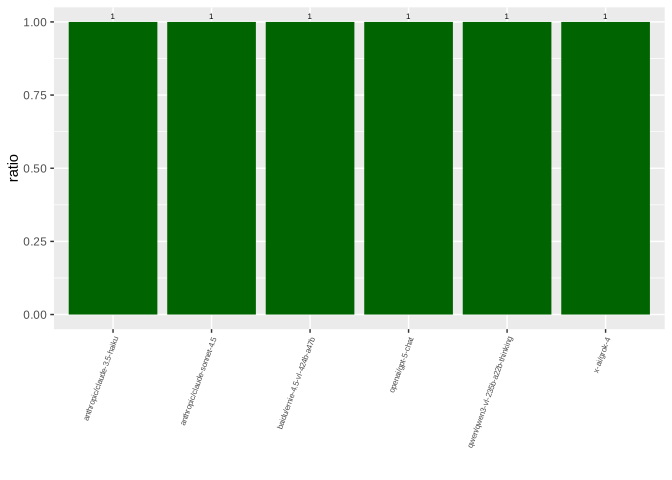
Figure 1.1: AI/ML Model Reliability
When a query to an LLM failed on the first attempt, it was retried automatically for a maximum of two further tries. That is to say, models with less than 100% success rate failed to produce a usable response on three attempts for at least one question.
1.2 Overall Competence of LLMs
When examining the competence of different LLMs to address tasks in a domain, we need to look at how models vary to determine if some models are more suitable than others to provide reliable insights into a discipline and then we can examine how models perform on different tasks within the domain.
Lets first get a sense of the overall competence of the LLMs for the types of tasks under examination. The performance of each model across all questions is shown in Table 1.1.
| Model | Correct Count | Valid Tests Count | Correct Ratio |
|---|---|---|---|
| anthropic/claude-3.5-haiku | 11 | 15 | 0.73 |
| anthropic/claude-sonnet-4.5 | 12 | 15 | 0.80 |
| baidu/ernie-4.5-vl-424b-a47b | 12 | 15 | 0.80 |
| openai/gpt-5-chat | 13 | 15 | 0.87 |
| qwen/qwen3-vl-235b-a22b-thinking | 13 | 15 | 0.87 |
| x-ai/grok-4 | 14 | 15 | 0.93 |
In Table 1.1, the three most competent models are highlighted in green and the three least competent models are highlighted in red. If you were, for example, recommending students use an LLM based application (chatbot or otherwise) in your discipline then the models highlighted in green would be a more appropriate starting point.
The differences are helpful highlighted in a chart, see Figure 1.2.
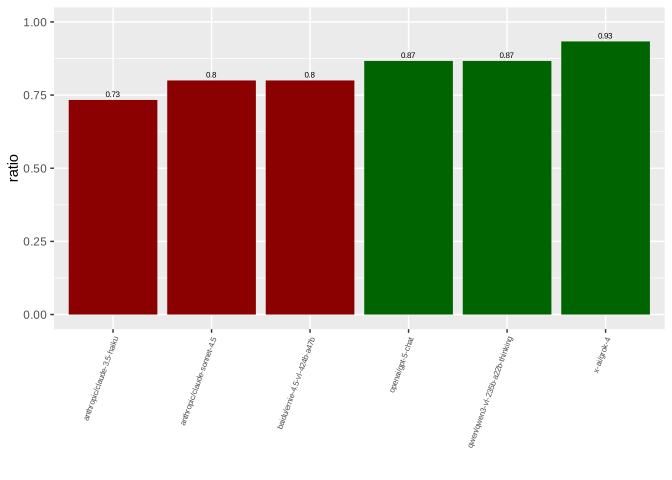
Figure 1.2: LLM Model MCQ Competence Overall
In Figure 1.2, the model with more than 80% competence based on the supplied questions are highlighted in green, the others in red. For an education support application, we would want to see high levels of competence in the models (and probably more than 85%).
If instead we are trying to identify if a set of questions can evaluate if students’ competence in the discipline exceeds available LLMs, we would want to see very low scores across all LLMs (probably less than 40%) in Table 1.1 and Figure 1.2.
If we see a wide range of scores across the LLMs, then the supplied tasks are a differentiator of LLM competence in the discipline.
1.3 Overall competence by question
With a sense of the general competence of the different LLMs we now identify the easiest and most difficult questions. Each question and the correct answer ratio is shown in Table 1.2.
In this table our colour-coding is on the assumption that you are trying to understand how much these tasks allow students to demonstrate that they can complete task beyond the competence of LLMs. Red links highlight those tasks that were completed successfully by a significant majority (85%+) of LLMs. Such tasks might be necessary for students to build skills. In such cases they should be guided to work on the tasks without using LLMs. If they red coded tasks are to be included in summative assessments, they would only be meaningful assessments in proctored examinations.
If instead you are trying to decide if and how to advise students about the potential for LLM based tools to help them master the material in your domain, the traffic lights must be reversed. Only the material highlighted in red are answered reliably enough that LLMs may may have a role to play as a tutorbot.
Of course, all of the tests in this report replicate the lazy user who only copy-pastes the task. The LLMs are likely to prove more competent if the user also added relevant documents to their queries.
Each question links to the output from all models later in the report.
| Question | Correct Count | Models Tested | Ratio Correct | |
|---|---|---|---|---|
| Role of the 4Ps | 0 | 6 | 0.00 | ⬤ |
| definitions | 6 | 6 | 1.00 | ⬤ |
| Role of models | 6 | 6 | 1.00 | ⬤ |
| Buyer behaviour models | 5 | 6 | 0.83 | ⬤ |
| Buying case (photography) | 6 | 6 | 1.00 | ⬤ |
| Photography case (tables) | 4 | 6 | 0.67 | ⬤ |
| Technology case (bounded rationality) | 5 | 6 | 0.83 | ⬤ |
| Technology case (methods evaluation) | 6 | 6 | 1.00 | ⬤ |
| Technology case (organisational buying) | 6 | 6 | 1.00 | ⬤ |
| DAMP | 6 | 6 | 1.00 | ⬤ |
| Relationship between UBB and Value proposition | 6 | 6 | 1.00 | ⬤ |
| Marketing segment scatter plots versus perceptual maps | 1 | 6 | 0.17 | ⬤ |
| Definitions of pricing methods | 6 | 6 | 1.00 | ⬤ |
| Restaurant mini-case (1) | 6 | 6 | 1.00 | ⬤ |
| Restaurant mini-case (2) | 6 | 6 | 1.00 | ⬤ |
This table is color-coded on the assumpting that we are evaluating the supplied tasks on their ability to measure students “beyond AI” knowledge and skills.
In Table 1.2, rows in red are questions successfully answered by at least 85% of the models. Rows in black were answered by at least 50% of the models. Green rows were answered by less than 50% of the models, suggesting material that is generally challenging for the LLMs, or very course specific (suggesting students are being challenged beyond LLM capabilities in these questions).
It is worth investigating any questions in green rows. It could be that the question draws on knowledge or skills beyond that of the LLMs. This is good for students. It can also highlight errors in general perceptions of the question, useful to highlight in classes. Or it could be that the LLMs are correct and that the answer key was incorrect.
Rows coloured red highlight tasks that are poor tests of students’ “beyond AI” knowledge and skills. It is important to remember that these are scores across all LLMs. Some LLMs may have performed very well across all of the supplied tasks.
1.4 Performance of the most popular LLMs
It is useful to just focus on the most commonly used LLMs.
As above, the tasks are colour-coded on the assumption that they are being used to evaluate students’ ability to perform tasks beyond the competence of basic LLMs. Red coded tasks are poor tests of students ‘beyond AI’ capabilities. Green coded tasks are good tests of students ‘beyond AI’ capabilities, at least at the most basic copy-paste level.
| Question | claude-sonnet-4 | llama-4-maverick | gpt-5-chat | |
|---|---|---|---|---|
| Buyer behaviour models | ✗ | ✓️ | ✓️ | ⬤ |
| Buying case (photography) | ✓ | ✓️ | ✓️ | ⬤ |
| DAMP | ✓ | ✓️ | ✓️ | ⬤ |
| Definitions of pricing methods | ✓ | ✓️ | ✓️ | ⬤ |
| Marketing segment scatter plots versus perceptual maps | ✗ | ✗ | ✓️ | ⬤ |
| Photography case (tables) | ✓ | ✓️ | ✓️ | ⬤ |
| Relationship between UBB and Value proposition | ✓ | ✓️ | ✓️ | ⬤ |
| Restaurant mini-case (1) | ✓ | ✓️ | ✓️ | ⬤ |
| Restaurant mini-case (2) | ✓ | ✓️ | ✓️ | ⬤ |
| Role of models | ✓ | ✓️ | ✓️ | ⬤ |
| Role of the 4Ps | ✗ | ✗ | ✗ | ⬤ |
| Technology case (bounded rationality) | ✗ | ✓️ | ✓️ | ⬤ |
| Technology case (methods evaluation) | ✓ | ✓️ | ✓️ | ⬤ |
| Technology case (organisational buying) | ✓ | ✓️ | ✓️ | ⬤ |
| definitions | ✓ | ✓️ | ✓️ | ⬤ |
In Table 1.3 we can see how three common LLMs performed on each task. As above, tasks coloured red are those that do not serve to differentiate students’ competence from the competence of the commonly used LLMs. Tasks coloured green are thon that the commonly used LLMs were not able to complete successfully.
2 AI Responses
2.1 Role of the 4Ps (01-01 Role of 4Ps.Rmd)
Role of the 4Ps
Which of the following best describes the role of 4Ps, as we are using them in this module?
A. The 4Ps are reduction of a complex set of attributes of market offerings that will need to be adapted or replaced completely as we focus on services.
B. The 4Ps are a definitive set of attributes that are used to specify all market offerings, and hence are to be treated as an iron law of successful marketing.
C. The 4Ps are a useful starting point for thinking about the the product we want to sell to consumers. They might be a bit rough, but are good enough to get us going.
D. The 4Ps are product, place, price, and promotion. They are the elements of the marketing mix.
For this task, 0 models from 7 were correct (0 / 7).
2.1.1 anthropic/claude-3.5-haiku (basic)
Answer: C. Expected Answer: A. Is correct: No
Explanation: The 4Ps (Product, Place, Price, Promotion) are a conceptual framework that provides a useful starting point for marketing analysis, but they are not a rigid or definitive set of attributes. The statement that they are ‘a useful starting point for thinking about the product we want to sell to consumers’ best captures their role - they are a helpful tool that can be adapted and refined, not an inflexible set of rules. While they do represent the marketing mix (as mentioned in option D), the key emphasis here is on their role as a flexible, initial framework for marketing thinking.
2.1.2 anthropic/claude-sonnet-4.5 (basic)
Answer: D. Expected Answer: A. Is correct: No
Explanation: Option D is the best answer as it correctly identifies what the 4Ps are (Product, Place, Price, and Promotion) and their role as elements of the marketing mix. This is the fundamental and widely accepted definition used in marketing education. Option A is incorrect as it suggests the 4Ps need to be replaced for services, which is too limiting. Option B is incorrect because it treats the 4Ps as an ‘iron law,’ which is too rigid - they are a framework, not absolute rules. Option C is incorrect because while it acknowledges the 4Ps as a starting point, it dismissively calls them ‘rough’ and ‘good enough,’ which undervalues their importance as a foundational marketing framework. Option D provides the most accurate and complete description of the 4Ps’ role in marketing.
2.1.3 baidu/ernie-4.5-vl-424b-a47b (basic)
Answer: C. Expected Answer: A. Is correct: No
Explanation: The 4Ps (product, place, price, promotion) are traditionally taught as the elements of the marketing mix. However, in modern marketing, especially in the context of services or digital offerings, they are often seen as a foundational framework rather than a rigid or definitive set of rules. Option C captures this by describing the 4Ps as a useful starting point that may be rough but sufficient to begin thinking about market offerings. Option A is incorrect because the 4Ps are not necessarily reduced or replaced when focusing on services; they can be adapted. Option B is incorrect because the 4Ps are not an iron law but a flexible framework. Option D, while factually correct in defining the 4Ps, does not address their role as a conceptual tool in the module’s context.
2.1.4 openai/gpt-5-chat (basic)
Answer: C. Expected Answer: A. Is correct: No
Explanation: In this context, the 4Ps (product, price, place, promotion) are presented as a practical framework for beginning to think about what a marketer offers and how it is positioned in the market. They are not treated as rigid rules (so B is too strong), nor dismissed as obsolete (so A is incorrect). While D defines what the 4Ps are, the question asks about their role in the module, which aligns best with option C.
2.1.5 qwen/qwen3-vl-235b-a22b-thinking (basic)
Answer: C. Expected Answer: A. Is correct: No
Explanation: Option C correctly describes the 4Ps as a practical starting point for marketing planning, acknowledging their foundational role while recognizing they may require refinement. The question asks for the role of the 4Ps in this module, implying a conceptual framework rather than a rigid rule (eliminating B) or a mere definition (eliminating D). Option A is incorrect because the module does not specify a focus on services requiring replacement of the 4Ps. C aligns with standard marketing education where the 4Ps serve as an initial, adaptable tool for structuring market offerings.
2.2 definitions (01-03 Product Definitions.Rmd)
Key definitions
We sometimes use the terms product, value proposition and market offering interchangeably. This is probably not a good idea. Which of the following best addresses that practice?
A. The word ‘offering’ in market offering suggests buyers have agency, they can accept or reject a marketer’s offer. This is useful because it moves beyond what Levitt (1960) calls the production orientation. The word ‘proposition’ in value proposition is important because it highlights the contingent nature of a market offering, it only has a particular value if used by the buyer in a particular way.
B. The premise of the question is false. The differences between the terms are not significant enough for us to be too worried at the moment.
C. The term product is always the best term to use because it is the first element of the 4Ps. Once we start complicating the matter, by using the other terms, then we undermine the value of the 4Ps approach.
D. The term product works very well for simple goods, where the value is primarily in the physical elements of the good (e.g., a tin of chopped tomatoes).
For this task, 7 models from 7 were correct (7 / 7).
2.2.1 anthropic/claude-3.5-haiku (basic)
Answer: A. Expected Answer: A. Is correct: Yes
Explanation: Option A provides the most nuanced and thoughtful explanation for why using these terms interchangeably is problematic. It highlights the key distinctions between the terms:
- ‘Offering’ implies buyer agency and moves beyond a production-oriented view
- ‘Proposition’ emphasizes the contingent nature of value - that value is not inherent but depends on how the buyer uses or perceives the product
The explanation recognizes that these terms are not simply synonyms, but carry different conceptual meanings that reflect different perspectives on market interactions. This approach encourages a more sophisticated understanding of marketing beyond just the physical product itself.
The other options are less compelling: - Option B dismisses the differences too casually - Option C overly prioritizes the 4Ps framework - Option D is too narrow, focusing only on physical goods
Therefore, Option A provides the most insightful analysis of the terminology.
2.2.2 anthropic/claude-sonnet-4.5 (basic)
Answer: A. Expected Answer: A. Is correct: Yes
Explanation: Option A best addresses why these terms should not be used interchangeably by explaining the distinct conceptual value of each term. ‘Market offering’ emphasizes buyer agency and choice, moving beyond production orientation. ‘Value proposition’ highlights that value is contingent on how the buyer uses the offering. These are meaningful distinctions that help marketers think more strategically. Option B dismisses the importance of the distinctions. Option C incorrectly suggests ‘product’ is always best and rigidly adheres to the 4Ps framework. Option D only partially addresses the issue by noting when ‘product’ works well but doesn’t explain why the distinctions matter overall.
2.2.3 baidu/ernie-4.5-vl-424b-a47b (basic)
Answer: A. Expected Answer: A. Is correct: Yes
Explanation: Option A best addresses the practice of using the terms interchangeably by highlighting the nuanced differences between them. It explains that ‘market offering’ emphasizes buyer agency, moving beyond a production-oriented view, while ‘value proposition’ underscores the contingent nature of value, which depends on the buyer’s use. This distinction is important for a deeper understanding of marketing concepts. The other options either dismiss the significance of the differences (B), overemphasize the 4Ps framework (C), or only partially address the issue by focusing on a specific context (D).
2.2.4 openai/gpt-5-chat (basic)
Answer: A. Expected Answer: A. Is correct: Yes
Explanation: Option A best addresses the issue of using ‘product’, ‘value proposition’, and ‘market offering’ interchangeably. It highlights the conceptual importance of ‘offering’ as an invitation to the market and ‘proposition’ as reflecting contingent value creation in use, distinguishing these terms beyond the production-oriented notion of a ‘product’. The other options either downplay these distinctions or emphasize a narrow, outdated view of marketing terminology.
2.2.5 qwen/qwen3-vl-235b-a22b-thinking (basic)
Answer: A. Expected Answer: A. Is correct: Yes
Explanation: Option A correctly distinguishes the terms by explaining the nuanced meanings: ‘market offering’ emphasizes buyer agency (acceptance/rejection), moving beyond production orientation, while ‘value proposition’ highlights the contingent nature of value based on buyer usage. This directly addresses why using the terms interchangeably is problematic. Options B, C, and D fail to justify the importance of differentiation: B dismisses the issue, C overemphasizes the 4Ps framework without addressing modern marketing perspectives, and D only partially applies to simple goods without explaining the broader conceptual distinctions.
2.2.6 x-ai/grok-4 (basic)
Answer: A. Expected Answer: A. Is correct: Yes
Explanation: Option A best addresses the practice by explaining the distinct nuances and importance of each term, highlighting why they should not be used interchangeably. It contrasts with B, which dismisses the concern; C, which favors one term without addressing interchangeability; and D, which is limited to specific cases.
2.3 Role of models (02-01 Models.Rmd)
Which of the following best describes the way we should treat models (such as the proposition acquisition process) in our study and practice of marketing?
A. Models are useful simplification (or abstractions) of complex phenomena (such as buyers’ decisions). They provide a starting point for organising that complexity and prompt questions that we might usefully ask as we try to solve our own, unique, marketing problems.
B. Models provide definitive simplifications (or abstractions) of phenomena (such as buyers’ decisions). The provide essential templates for us to use as we quickly solve complex problems.
C. We should be sceptical about most models. As Godwin (2019) correctly notes, marketing definitions are the result of university professors and commercial marketing consultants trying to out-smart each other, and sell more books. The same applies to models of key marketing phenomena.
D. Models are a useful educational device, to help us learn to think. In practice, unfortunately, they never apply, and we should put them aside and focus on real life once we have a marketing job.
For this task, 7 models from 7 were correct (7 / 7).
2.3.1 anthropic/claude-3.5-haiku (basic)
Answer: A. Expected Answer: A. Is correct: Yes
Explanation: Option A is the most appropriate way to view marketing models. Models are not definitive or absolute solutions (ruling out option B), nor are they completely dismissible as academic exercises (ruling out option C). They are useful simplifications that help us organize complex phenomena like buyer decisions, provide a starting framework, and prompt critical questions. Option D incorrectly suggests models are only educational and not practically useful. A good model helps us understand complexity by breaking it down, offering insights and a structured approach to analyzing marketing challenges, while recognizing that real-world situations are always more nuanced than any single model can fully capture.
2.3.2 anthropic/claude-sonnet-4.5 (basic)
Answer: A. Expected Answer: A. Is correct: Yes
Explanation: Option A best describes the appropriate treatment of marketing models. Models like the proposition acquisition process are useful simplifications that help organize complex phenomena and guide thinking, but they are not definitive solutions. They serve as frameworks to prompt relevant questions for specific marketing problems. Option B is incorrect because it suggests models are ‘definitive’ and provide ‘essential templates’ for quick solutions, which overstates their rigidity and applicability. Option C is overly cynical and dismisses the legitimate academic and practical value of models. Option D incorrectly suggests models have no practical application in real-world marketing, when in fact they remain valuable tools for structuring thinking and problem-solving in practice, even if they require adaptation to specific contexts.
2.3.3 baidu/ernie-4.5-vl-424b-a47b (basic)
Answer: A. Expected Answer: A. Is correct: Yes
Explanation: Option A correctly describes models as useful simplifications or abstractions of complex phenomena, such as buyers’ decisions. Models serve as a starting point for organizing complexity and prompting useful questions when addressing unique marketing problems. Option B is incorrect because models are not definitive templates for quickly solving complex problems; they are simplifications that require adaptation. Option C is overly skeptical and dismissive of models, which are valuable tools in marketing despite potential limitations. Option D is incorrect because models are not merely educational devices; they have practical applications in real-world marketing scenarios.
2.3.4 openai/gpt-5-chat (basic)
Answer: A. Expected Answer: A. Is correct: Yes
Explanation: Models in marketing, such as the proposition acquisition process, are best viewed as useful simplifications of complex realities like consumer decision-making. They help organize thinking, identify relevant variables, and prompt insightful questions. However, they are not definitive or universally applicable templates, and they should not be dismissed outright once we move into practice. Therefore, option A accurately reflects the appropriate way to use models in marketing study and practice.
2.3.5 qwen/qwen3-vl-235b-a22b-thinking (basic)
Answer: A. Expected Answer: A. Is correct: Yes
Explanation: Option A correctly describes models as useful simplifications that help organize complex phenomena and guide problem-solving by prompting relevant questions. This aligns with the academic understanding that models like the proposition acquisition process are abstractions meant to provide structure without claiming definitive solutions. Options B, C, and D are incorrect: B overstates models as ‘definitive templates’ (they require adaptation), C is overly skeptical without valid justification (the Godwin reference appears fabricated and misrepresents scholarly consensus), and D wrongly claims models ‘never apply’ in practice (they inform real-world strategies when adapted contextually).
2.3.6 x-ai/grok-4 (basic)
Answer: A. Expected Answer: A. Is correct: Yes
Explanation: Option A best describes a balanced and practical approach to treating models in marketing as useful simplifications that aid in organizing complexity and prompting relevant questions, without overclaiming their definitiveness or dismissing their value entirely, unlike the other options which are either too rigid, skeptical, or dismissive.
2.4 Buyer behaviour models (02-04 Buyer behaviour models.Rmd)
Which of the following is the best comprehensive summary of the common elements of different models of buyer behaviour?
A. Buyer behaviour starts with a recognition of needs and wants, and then moves through steps involving the identification and evaluation of solutions, the acquisition of the solution, use, and post-purchase evaluation.
B. All buyer behaviour models start with a consumer or an organisational buyer recognising a need or want.
C. At first, consumers or organisations recognise a need or want. Those needs or wants could be categorised as necessities or luxuries, or we could use a more sophisticated set of categories, such as that suggested by Maslow’s (1943) Hierarchy of Needs.
D. Information search can be internal or external. Internal search involves search of the individual or organisational memory. External search involves accessing information beyond personal, family, or organisational memory, for example through web searches, asking family, friends, or employing experts.
E. Buyers will have different degrees of sophistication in how they can analyse and evaluate the competing market offers that might satisfy their needs and wants. Understanding these different abilities helps marketers produce marketing communications suited to those different abilities.
F. An ignored aspect to all the models is disposal. Ethical marketers should should be conscious of how their products produce waste, how that waste is processed, and the impact of that waste on the environment.
For this task, 6 models from 7 were correct (6 / 7).
2.4.1 anthropic/claude-3.5-haiku (basic)
Answer: A, B, C, D. Expected Answer: A. Is correct: No
Explanation: These options collectively provide a comprehensive summary of common elements in buyer behaviour models. Option A outlines the typical stages of buyer behaviour from need recognition to post-purchase evaluation. Option B highlights the universal starting point of recognizing a need or want. Option C adds depth by discussing the categorization of needs, referencing Maslow’s Hierarchy of Needs. Option D explains the types of information search (internal and external) that buyers typically engage in. These options together capture the key components and processes common across different models of buyer behaviour. Options E and F, while potentially interesting, are more specific insights rather than fundamental elements shared across models.
2.4.2 anthropic/claude-sonnet-4.5 (basic)
Answer: A. Expected Answer: A. Is correct: Yes
Explanation: Option A provides the best comprehensive summary of common elements across different buyer behaviour models. It captures the complete buyer journey that is present in most models: (1) need/want recognition, (2) information search and identification of solutions, (3) evaluation of alternatives, (4) purchase/acquisition, (5) use, and (6) post-purchase evaluation. This sequence represents the core framework found in classic models like the Consumer Decision Process and similar organizational buying models. Options B and C only cover the initial stage (need recognition), Option D focuses solely on information search, Option E addresses only evaluation capabilities, and Option F discusses disposal which, while important, is not a common element across most traditional buyer behaviour models. Option A is the only choice that comprehensively summarizes the full process common to different models.
2.4.3 baidu/ernie-4.5-vl-424b-a47b (basic)
Answer: A. Expected Answer: A. Is correct: Yes
Explanation: Option A provides the most comprehensive summary of the common elements of different models of buyer behaviour. It outlines the entire process, starting from need recognition, moving through identification and evaluation of solutions, acquisition, use, and post-purchase evaluation. This captures the full sequence typically described in buyer behaviour models. The other options focus on specific aspects (e.g., need recognition in B and C, information search in D, evaluation sophistication in E, or disposal in F) but do not encompass the entire process as comprehensively as A.
2.4.4 openai/gpt-5-chat (basic)
Answer: A. Expected Answer: A. Is correct: Yes
Explanation: Option A captures the full sequence common to most buyer behaviour models—beginning with need recognition, proceeding through information search, evaluation of alternatives, purchase, use, and post-purchase evaluation. The other options describe parts or specific aspects of the process but do not summarise all the key stages comprehensively.
2.4.5 qwen/qwen3-vl-235b-a22b-thinking (basic)
Answer: A. Expected Answer: A. Is correct: Yes
Explanation: Option A provides a comprehensive summary of the common elements across buyer behaviour models by outlining the sequential process: need recognition, solution identification/evaluation, acquisition, use, and post-purchase evaluation. This captures the core stages present in most models (e.g., consumer decision process). Other options (B-F) focus on isolated components (e.g., only need recognition, information search, or disposal) rather than the full spectrum of common elements. While B is partially correct about the starting point, it lacks the holistic structure required for a comprehensive summary.
2.4.6 x-ai/grok-4 (basic)
Answer: A. Expected Answer: A. Is correct: Yes
Explanation: Option A provides the most comprehensive summary of the common elements in buyer behavior models, outlining the key stages from need recognition to post-purchase evaluation, which aligns with standard models like the consumer decision-making process.
2.5 Buying case (photography) (02-05 Buying Case (photography).Rmd)
Photographer mini-case (1)
You have a classmate whose primary hobby is photography. It is a purely personal hobby that helps them feel a sense of creative and artistic fulfilment.
Because their budget is very constrained, your classmate will not buy a new camera. Instead they are making the most of their existing equipment. Each weekend they work on a small photographic project (e.g., taking photographs of skyscrapers, market stalls, or autumn leaves).
On Friday evening, they look at the websites of professional photographers and Magnum, the foremost agency for professional photographers. They also search Flikr for examples of photographs related to their project. Your classmate makes notes about the techniques and styles they would like to try. On Saturday, they spend the day taking photographs, implemented the techniques they have noted. On Sunday they review their photographs, reflect on what worked and did not work, and set themselves a task for the following weekend.
Which of the following is the best ‘translation’ of your classmate’s behaviour into the terms of the buyer behaviour models you have studied?
A. The classmate has a high level need or want for self-actualisation as a creative individual, and is working at the top of Maslow’s (1943) hierarchy. They undertake extensive external information search to help fulfill that need. The classmate can evaluate different information sources with a degree sophistication and expertise. They address their need or want without a financial purchase, but they pay in terms of the time and intellectual effort they expend. They are very diligent in their post-acquisition evaluation.
B. The premise of the question is incorrect. No purchase has been made. There is no buyer and, therefore, buyer behaviour models are inappropriate. Instead, we should find or create a new model specifically for cases when needs and wants are addressed without resorting to market solutions.
C. The description of the behaviour and the prompt to think about it in terms of buyer behaviour is thought provoking. It highlights that, at the broadest levels, the models have general usefulness. But, I would want to interview my classmate in depth to evaluate if the models are suitable as a starting point, and to decide how much the models might need to be adapted to analyse cases like this one.
D. The key to understanding this short case is in the detail about the ‘post-purchase’ behaviour. The sense that our classmate diligently reflects on their ‘purchase’ is instructive; it is the basis for developing consumer expertise. But, it is atypical. Most consumers just buy stuff, consume it, and don’t think about it again. Our classmate is more like sophisticated organisation than the typical consumer, even though they spent not one penny!
For this task, 7 models from 7 were correct (7 / 7).
2.5.1 anthropic/claude-3.5-haiku (basic)
Answer: A. Expected Answer: A. Is correct: Yes
Explanation: Option A provides the most comprehensive and insightful analysis of the classmate’s photographic behavior using buyer behavior models. It effectively applies Maslow’s hierarchy of needs, specifically the self-actualization level, to explain the creative pursuit. The answer highlights key aspects of the classmate’s behavior:
- Self-actualization need: Pursuing photography as a creative outlet
- Extensive external information search: Studying professional photographers’ websites and Flickr
- Sophisticated information evaluation: Carefully noting techniques and styles
- Non-financial ‘purchase’: Investing time and intellectual effort
- Thorough post-acquisition evaluation: Reflecting on results and planning future improvements
While the other options raise interesting points, they either dismiss the applicability of buyer behavior models (B), suggest further investigation without providing a clear analysis (C), or focus too narrowly on post-purchase behavior (D). Option A provides the most nuanced and comprehensive interpretation of the case using established buyer behavior frameworks.
2.5.2 anthropic/claude-sonnet-4.5 (basic)
Answer: A. Expected Answer: A. Is correct: Yes
Explanation: Option A provides the best translation of the classmate’s behavior into buyer behavior model terms. It correctly identifies: (1) the self-actualization need at the top of Maslow’s hierarchy, (2) extensive external information search (Friday research), (3) sophisticated evaluation of information sources (professional photographers, Magnum, Flickr), (4) addressing needs without financial purchase but with time/effort investment, and (5) thorough post-acquisition evaluation (Sunday reflection). Option B is incorrect because buyer behavior models can be applied to non-monetary exchanges where consumers invest time and effort. Option C is overly cautious and doesn’t commit to an analysis when the models clearly apply well. Option D focuses too narrowly on just the post-purchase behavior and makes unsupported generalizations about typical consumers, missing the comprehensive application of the buyer behavior framework that Option A provides.
2.5.3 baidu/ernie-4.5-vl-424b-a47b (basic)
Answer: A. Expected Answer: A. Is correct: Yes
Explanation: The classmate’s behavior aligns with buyer behaviour models by framing their hobby as a pursuit of self-actualization, a concept from Maslow’s hierarchy of needs. They engage in an external information search (reviewing professional websites and Flickr), evaluate sources with expertise, and invest time and effort instead of money. Their post-acquisition evaluation (reviewing photographs and setting future tasks) mirrors consumer reflection processes. Option B is incorrect because buyer behaviour models can apply to non-purchase scenarios involving needs and information search. Option C overcomplicates the analysis; the case fits existing models without requiring new interviews. Option D misrepresents the case; the classmate’s diligence is not atypical for a hobbyist pursuing expertise and aligns with consumer behaviour in non-monetary contexts.
2.5.4 openai/gpt-5-chat (basic)
Answer: A. Expected Answer: A. Is correct: Yes
Explanation: Option A best captures the application of buyer behaviour concepts to the classmate’s behaviour. Although no money is spent, their actions map closely onto the consumer decision-making process: recognizing a need for creative fulfillment (a self-actualisation motive at the top of Maslow’s hierarchy), undertaking external information search (researching professional and amateur photography techniques), evaluating options, engaging in ‘purchase’ or consumption (taking photographs), and conducting post-purchase evaluation (reviewing results and setting new tasks). The other options either reject or qualify the applicability of buyer behaviour models rather than interpreting the case directly within that framework.
2.5.5 qwen/qwen3-vl-235b-a22b-thinking (basic)
Answer: A. Expected Answer: A. Is correct: Yes
Explanation: Option A correctly applies buyer behavior models by recognizing that the classmate’s process aligns with key elements like motivation (Maslow’s self-actualization), extensive external information search, and post-acquisition evaluation, even without a financial purchase. The model adapts to non-monetary costs (time/effort) and emphasizes the behavioral parallels in the decision-making process. Option B is overly rigid, as buyer behavior models can extend beyond purchases to include non-market solutions. Option C is vague and doesn’t directly translate the behavior, while Option D incorrectly frames the reflection as ‘post-purchase’ when no purchase occurred.
2.5.6 x-ai/grok-4 (basic)
Answer: A. Expected Answer: A. Is correct: Yes
Explanation: Option A best translates the classmate’s behavior into buyer behavior models by mapping it to need recognition (self-actualization), extensive information search, evaluation of sources, non-financial ‘purchase’ via time and effort, and post-acquisition evaluation. Other options either reject the application of models (B), suggest further research without direct translation (C), or focus narrowly on one aspect (D).
2.6 Photography case (tables) (02-06 Buying Case (photography) tables.Rmd)
Photographer mini-case (2)
You have a classmate whose primary hobby is photography. It is a purely personal hobby that helps them feel a sense of creative and artistic fulfilment.
Because their budget is very constrained, your classmate will not buy a new camera. Instead they are making the most of their existing equipment. Each weekend they work on a small photographic project (e.g., taking photographs of skyscrapers, market stalls, or autumn leaves).
On Friday evening, they look at the websites of professional photographers and Magnum, the foremost agency for professional photographers. They also search Flikr for examples of photographs related to their project. Your classmate makes notes about the techniques and styles they would like to try. On Saturday, they spend the day taking photographs, implemented the techniques they have noted. On Sunday they review their photographs, reflect on what worked and did not work, and set themselves a task for the following weekend.
Mindful of the details above consider, the following table:
| Step | Detail |
|---|---|
| Recognition of need or want | To self-actualise their creative self |
| Information search | |
| Evaluation of alternatives | |
| Acquisition | |
| Post-purchase behaviour | Reflect on improvement to photography |
Which of the following would make the best improvement to the table? Think about the accuracy and sophistication of the improvement.
A. Edit the general model (first column) to change the last two steps to something like ‘primary behaviour’ and ‘post primary behaviour’, which better reflect the non-commercial nature of the behaviour. In the second column add the details for search (mostly external), evaluation (somewhat expert, and developing), primary behaviour (taking of the photographs), and post primary behaviour (critical reflection, future planning).
B. For the information search step, the following detail should be added: extensive external information search, especially of sites by or for professionals, and which are free to access.
C. Some changes to the model are needed because the model is built on the analysis of market behaviour, not non-market behaviour. We would want to gather more data before we edited the model or tried to specify it by filling the empty boxes based only on the information in the previous question.
D. Again, the premise of the task is false. We are being asked to fit non-commercial behaviour into a model that is designed to provide a high-level abstraction of buyers’ engagement with the market.
For this task, 4 models from 7 were correct (4 / 7).
2.6.1 anthropic/claude-3.5-haiku (basic)
Answer: A. Expected Answer: A. Is correct: Yes
Explanation: Option A provides the most sophisticated and accurate improvement to the table. It recognizes that the consumer behavior model needs to be adapted for a non-commercial, creative pursuit. The proposed changes capture the nuanced nature of the photographer’s process:
- Changing the last two steps to ‘primary behaviour’ and ‘post primary behaviour’ acknowledges that this is not a typical market transaction.
- The details added for each step are specific and reflective of the photographer’s actual workflow:
- Information search: External, professional sources
- Evaluation: Expert-level and developmental
- Primary behaviour: Actual photography
- Post primary behaviour: Critical reflection and future planning
This approach demonstrates a thoughtful modification of the standard consumer behavior model to fit a personal, creative pursuit, rather than rejecting the model entirely or attempting to force it into a commercial framework. The proposed changes show an understanding of the unique characteristics of creative hobby-based behavior.
2.6.2 anthropic/claude-sonnet-4.5 (basic)
Answer: C. Expected Answer: A. Is correct: No
Explanation: Option C is the most sophisticated and accurate response. The question asks about improving a consumer decision-making model (recognition of need → information search → evaluation of alternatives → acquisition → post-purchase behavior) that is being applied to non-commercial, hobby photography behavior. Option C correctly identifies that: (1) the model is designed for market/commercial behavior, not non-market behavior; (2) we should gather more data before attempting to modify the model or fill in the gaps; and (3) it’s premature to specify details based only on limited information. This demonstrates methodological rigor and acknowledges the limitations of applying commercial frameworks to non-commercial contexts. Option A makes assumptions and fills in details without sufficient justification. Option B only addresses one step superficially. Option D is too dismissive - while the model may not fit perfectly, it’s not necessarily a ‘false premise’ to explore adaptations, but C’s cautious, data-driven approach is more academically sound.
2.6.3 baidu/ernie-4.5-vl-424b-a47b (basic)
Answer: B. Expected Answer: A. Is correct: No
Explanation: The question asks for the best improvement to the table based on the given scenario. The scenario describes a non-commercial, personal hobby where the classmate engages in photography as a creative pursuit. Option B directly addresses the ‘Information search’ step by specifying that the classmate conducts an extensive external information search, particularly on free professional sites like Magnum and Flickr. This is accurate and sophisticated because it aligns with the details provided (e.g., looking at professional websites and Flickr on Friday evenings). Option A suggests renaming steps to ‘primary behaviour’ and ‘post primary behaviour’, but this is unnecessary and overly complex for the given scenario. Option C suggests gathering more data before editing the model, but the scenario provides sufficient information to fill in the table. Option D claims the model is unsuitable for non-commercial behaviour, but the question explicitly asks to fit the behaviour into the model, and Option B demonstrates how to do this effectively.
2.6.4 openai/gpt-5-chat (basic)
Answer: A. Expected Answer: A. Is correct: Yes
Explanation: Option A best improves the table because it adapts the traditional consumer decision-making model (which assumes a purchase process) to a non-market, creative behaviour. By relabeling ‘acquisition’ and ‘post-purchase behaviour’ as ‘primary behaviour’ and ‘post primary behaviour,’ the model more accurately reflects the photographer’s self-directed, non-commercial activity. Options B, C, and D either focus too narrowly on one step or reject the exercise rather than constructively improving the model.
2.6.5 qwen/qwen3-vl-235b-a22b-thinking (basic)
Answer: A. Expected Answer: A. Is correct: Yes
Explanation: The original table uses a consumer decision-making model designed for commercial transactions, but the scenario describes non-commercial, creative behavior. Option A correctly addresses this by redefining the last two steps to ‘primary behaviour’ (taking photographs) and ‘post primary behaviour’ (reflection/planning), which accurately reflect the hobbyist’s process without forcing a purchase framework. This improves both accuracy and sophistication by adapting the model to non-market behavior. Option B adds detail but ignores the structural mismatch in the model. Options C and D dismiss the task unnecessarily, as the scenario provides sufficient context to refine the model.
2.6.6 x-ai/grok-4 (basic)
Answer: A. Expected Answer: A. Is correct: Yes
Explanation: Option A provides the most accurate and sophisticated improvement by adapting the consumer behavior model to fit the non-commercial, hobbyist context through renaming steps and adding relevant details, ensuring the table better reflects the described behavior without forcing a market-oriented framework.
2.7 Technology case (bounded rationality) (03-02 Technology Case (bounded rationality).Rmd)
Technology marketing mini-case (2)
Imagine you are working as a marketer in a technology firm that makes, and sells, laptops, primarily to students. Under the direction of your manager, you have been undertaking buyer behaviour research to understand how different buyers make their decisions to buy a laptop, to buy another computing device (such as a tablet or desktop), or to not buy at all.
You have timed your research so that your informants are making their decisions while you undertake the research. You are able to meet with them multiple times as they make their decision, and after they have acquired the new device, or chosen not to, to see how they work and evaluate their choice.
You are using long interviews, at your informants’ homes, and you are encouraging them to review instant messages, web browsing histories, phone logs, to ensure that you get rich data. You also talk to family members involved in the decision (e.g., parents or siblings have contributed to discussions, given advice, or helped with the finances).
As you analyse the interview data you see that a number of informants are making their decision based on two factors only, brand and price, while others have quite detailed notes (including spreadsheets) that compared and rated different laptops based on screen size, processor type and speed, graphics capabilities, and so on. Your informants provide you with copies of this information as it evolves, and you consider it as you analyse your records of observations and discussions.
When you discuss the needs and wants of your informants, including budget constraints, with the technology experts in your company, they tell you that some of the decisions the informants made just don’t make sense, with one colleague describing those informants as ‘fools’. They note this particularly when the informants relied on brand name, and could have bought a better value laptop from a less well known brand.
When your colleagues who are technology experts describe some of your informants as fools, what buyer behaviour phenomenon are we witnessing?
A. This is a case of bounded rationality, it means that people (including buyers) make decisions with limited information and limited skills. Different buyers will have different limits.
B. This is a case of elitism by engineering and computer science professionals, who think they are superior to ordinary buyers (and marketers).
C. This is evidence of a market research problem because you have not been able to identify the real reasons the buyers are making decisions, and have lazily ascribed ‘brand loyalty’ as the reason.
D. This is a case of poor choice of methods. If another research method had been chosen, your colleagues would see the hidden expertise of those buyers and not dismiss them as fools.
For this task, 6 models from 7 were correct (6 / 7).
2.7.1 anthropic/claude-3.5-haiku (basic)
Answer: A, B. Expected Answer: A. Is correct: No
Explanation: This scenario demonstrates two key phenomena:
Bounded Rationality (A): The buyers are making decisions with limited information and different cognitive capabilities. Some buyers use simple criteria like brand and price, while others create detailed comparisons. This reflects the concept of bounded rationality, where people make satisficing (not optimizing) decisions based on their cognitive limitations and available information.
Professional Elitism (B): The technology experts’ dismissive attitude of calling buyers ‘fools’ for making decisions based on brand name reveals a form of professional elitism. They are judging consumer decisions from a purely technical perspective, without understanding the psychological and social factors that influence purchasing choices.
The other options are less compelling: - Option C mischaracterizes the market research - Option D suggests a methodological problem, which is not supported by the case details
Therefore, both A and B provide valid insights into the buyer behavior phenomenon described in the case.
2.7.2 anthropic/claude-sonnet-4.5 (basic)
Answer: A. Expected Answer: A. Is correct: Yes
Explanation: This is a clear case of bounded rationality. The research methodology described is actually quite thorough - using long interviews, multiple touchpoints, reviewing actual decision-making artifacts (spreadsheets, notes), and talking to family members. This rules out options C and D, which suggest methodological problems. The research has successfully identified the real reasons buyers are making decisions (brand and price for some, detailed technical comparisons for others). Option B, while the colleagues may indeed be displaying some elitism, doesn’t describe the buyer behavior phenomenon itself - it describes the colleagues’ reaction. Option A correctly identifies that the buyers using brand and price as their primary criteria are exhibiting bounded rationality - they are making rational decisions within their own constraints of information, time, cognitive ability, and expertise. Not everyone has the technical knowledge to evaluate processor speeds and graphics capabilities, so relying on brand as a heuristic for quality is a rational simplification strategy. The technology experts are judging these buyers by their own expert standards, failing to recognize that different buyers have different information processing capabilities and constraints, which is the essence of bounded rationality in consumer behavior.
2.7.3 baidu/ernie-4.5-vl-424b-a47b (basic)
Answer: A. Expected Answer: A. Is correct: Yes
Explanation: The scenario describes buyers making decisions based on limited factors like brand and price, while others conduct detailed technical evaluations. The technology experts dismiss those relying on brand as ‘fools’ because they fail to recognize that buyers often operate with bounded rationality—making decisions based on simplified heuristics due to limited information, time, or cognitive resources. This concept explains why some buyers prioritize brand or price over technical specifications, as they lack the expertise or inclination to evaluate complex details. The other options are less relevant: elitism (B) is a possible bias but not the core phenomenon; market research issues (C) or methodological flaws (D) are not indicated, as the research captured rich data and diverse decision-making approaches.
2.7.4 openai/gpt-5-chat (basic)
Answer: A. Expected Answer: A. Is correct: Yes
Explanation: This is a case of bounded rationality. Buyers make decisions based on limited information, cognitive constraints, and personal preferences rather than complete rational analysis. The informants relying on brand and price are demonstrating decision-making within their cognitive and informational limits, which explains why their choices may not appear optimal to the technology experts.
2.7.5 qwen/qwen3-vl-235b-a22b-thinking (basic)
Answer: A. Expected Answer: A. Is correct: Yes
Explanation: The scenario describes buyers making decisions based on limited factors (e.g., brand and price) despite more optimal options being available, which aligns with bounded rationality. This concept explains that buyers use simplified decision-making due to cognitive limits, time constraints, or incomplete information, rather than always seeking the ‘best’ technical value. The tech experts’ dismissal as ‘fools’ reflects a failure to recognize these real-world decision constraints, not elitism (B), research flaws (C), or method issues (D).
2.7.6 x-ai/grok-4 (basic)
Answer: A. Expected Answer: A. Is correct: Yes
Explanation: The scenario illustrates bounded rationality in buyer behavior, where some informants make decisions using limited factors like brand and price due to constraints on information and skills, rather than optimizing every detail. The tech experts’ dismissal highlights this phenomenon, as they assume buyers should make fully rational choices like experts.
2.8 Technology case (methods evaluation) (03-04 Technology Case (evaluate method).Rmd)
Technology marketing mini-case (4)
Imagine you are working as a marketer in a technology firm that makes, and sells, laptops, primarily to students. Under the direction of your manager, you have been undertaking buyer behaviour research to understand how different buyers make their decisions to buy a laptop, to buy another computing device (such as a tablet or desktop), or to not buy at all.
You have timed your research so that your informants are making their decisions while you undertake the research. You are able to meet with them multiple times as they make their decision, and after they have acquired the new device, or chosen not to, to see how they work and evaluate their choice.
You are using long interviews, at your informants’ homes, and you are encouraging them to review instant messages, web browsing histories, phone logs, to ensure that you get rich data. You also talk to family members involved in the decision (e.g., parents or siblings have contributed to discussions, given advice, or helped with the finances).
As you analyse the interview data you see that a number of informants are making their decision based on two factors only, brand and price, while others have quite detailed notes (including spreadsheets) that compared and rated different laptops based on screen size, processor type and speed, graphics capabilities, and so on. Your informants provide you with copies of this information as it evolves, and you consider it as you analyse your records of observations and discussions.
When you discuss the needs and wants of your informants, including budget constraints, with the technology experts in your company, they tell you that some of the decisions the informants made just don’t make sense, with one colleague describing those informants as ‘fools’. They note this particularly when the informants relied on brand name, and could have bought a better value laptop from a less well known brand.
Which of the following is the best critical evaluation of the method?
A. It is a good method for identifying the factors different buyers consider as they make their decision. But, our analysis would not allow us to know whether some needs or wants were more prevalent than others, whether there were patterns in the type of information search, methods of evaluation of alternatives, etc. We would need to undertake some additional research to address those weaknesses.
B. It is a poor method because it does not allow us to know whether some needs or wants were more prevalent than others, whether there were patterns in the type of information search, methods of evaluation of alternatives, etc. We would need to scrap this research and try again with a more objective research method.
C. Research methods such as the one described are good for understanding emotional, whimsical or irrational decisions. Choosing a computer is always a rational, objective decision, and we should have chosen a research method that gathered more ‘hard data’.
D. Methods such as the one above generate so much rich data that any criticism is unreasonable. The problem is that, as Boddy (2011) reported, too few market researchers are able to design and implement this research method.
For this task, 7 models from 7 were correct (7 / 7).
2.8.1 anthropic/claude-3.5-haiku (basic)
Answer: A. Expected Answer: A. Is correct: Yes
Explanation: Option A provides the most balanced and constructive critique of the research method. The method is valuable for understanding individual buyer decision-making processes, but it has limitations in terms of identifying broader patterns and prevalence of needs or wants. The suggestion to conduct additional research to address these weaknesses shows a nuanced understanding of qualitative research methods.
Option B is too dismissive, suggesting scrapping the entire research approach. Option C incorrectly assumes computer purchasing is always rational, which contradicts the rich data showing varied decision-making approaches. Option D is overly laudatory and uncritical, dismissing any potential methodological limitations.
The described research method (long interviews, multiple touchpoints, rich contextual data) is a strong qualitative approach, but as Option A suggests, it would benefit from complementary research to draw more generalizable insights about buyer behavior in the laptop market.
2.8.2 anthropic/claude-sonnet-4.5 (basic)
Answer: A. Expected Answer: A. Is correct: Yes
Explanation: Option A provides the most balanced and accurate critical evaluation of the qualitative research method described. The method (longitudinal, in-depth interviews with multiple touchpoints) is indeed excellent for understanding the factors individual buyers consider and the decision-making process in rich detail. However, as a qualitative approach with what appears to be a limited sample, it cannot reliably determine prevalence of patterns, statistical significance, or generalizability across the broader population. Option A correctly identifies both the strengths (understanding factors and decision processes) and limitations (inability to quantify patterns or prevalence) while suggesting complementary research to address weaknesses. Option B is too harsh in dismissing the research entirely. Option C incorrectly assumes computer purchases are always rational decisions (the case shows brand-based decisions exist) and mischaracterizes the method’s purpose. Option D uncritically accepts the method without acknowledging legitimate limitations regarding generalizability and pattern prevalence that qualitative methods inherently have.
2.8.3 baidu/ernie-4.5-vl-424b-a47b (basic)
Answer: A. Expected Answer: A. Is correct: Yes
Explanation: The described method involves in-depth interviews, observation, and collection of rich data from informants and their families during the decision-making process. This approach is effective for identifying the factors individual buyers consider, such as brand and price versus detailed technical specifications. However, it has limitations in identifying broader patterns, such as the prevalence of certain needs or wants across the sample, common information search behaviors, or evaluation methods. Option A correctly acknowledges the method’s strength in identifying individual factors while pointing out the need for additional research to address its weaknesses in identifying patterns. Option B is overly critical and suggests scrapping the research, which is unnecessary as the method has value. Option C incorrectly assumes that computer purchases are always rational, ignoring the role of brand perception and other non-technical factors. Option D unreasonably dismisses criticism and misattributes the issue to a lack of researcher skill, which is not the primary concern here.
2.8.4 openai/gpt-5-chat (basic)
Answer: A. Expected Answer: A. Is correct: Yes
Explanation: Option A is correct because the qualitative, longitudinal interview method described is strong for understanding how different buyers make decisions, uncovering the factors influencing their choices, and capturing rich, contextual data. However, it is limited in its ability to generalize or quantify the prevalence of certain needs, wants, or patterns in decision-making; additional quantitative research would be necessary for that. Option B is incorrect because it overstates the limitation and wrongly suggests the research should be discarded. Option C is wrong because not all purchase decisions are purely rational, and the chosen qualitative method is suitable for understanding both rational and emotional factors. Option D is incorrect because claiming any criticism is unreasonable is not a balanced critical evaluation.
2.8.5 qwen/qwen3-vl-235b-a22b-thinking (basic)
Answer: A. Expected Answer: A. Is correct: Yes
Explanation: The method described is a qualitative, in-depth approach that effectively captures the decision-making process and factors considered by buyers (e.g., brand, price, technical specs). However, qualitative methods like this are limited in quantifying prevalence or identifying statistical patterns across a broader population. Option A correctly acknowledges the method’s strength in identifying factors while noting the need for additional research (e.g., quantitative surveys) to assess prevalence or patterns. Option B is overly dismissive, as qualitative methods are valid for exploratory insights. Option C incorrectly assumes laptop purchases are always rational, ignoring emotional/brand-driven decisions observed in the data. Option D overstates the method’s completeness, as all research methods have limitations requiring complementary approaches.
2.8.6 x-ai/grok-4 (basic)
Answer: A. Expected Answer: A. Is correct: Yes
Explanation: Option A correctly identifies the method’s strength in uncovering qualitative insights into decision factors while acknowledging its limitations in quantifying prevalence or patterns, suggesting complementary research rather than dismissal.
2.9 Technology case (organisational buying) (03-05 Technology Case (DMU and buyphases).Rmd)
Technology marketing mini-case (5)
Imagine you are working as a marketer in a technology firm that makes, and sells, laptops, primarily to students. Under the direction of your manager, you have been undertaking buyer behaviour research to understand how different buyers make their decisions to buy a laptop, to buy another computing device (such as a tablet or desktop), or to not buy at all.
You have timed your research so that your informants are making their decisions while you undertake the research. You are able to meet with them multiple times as they make their decision, and after they have acquired the new device, or chosen not to, to see how they work and evaluate their choice.
You are using long interviews, at your informants’ homes, and you are encouraging them to review instant messages, web browsing histories, phone logs, to ensure that you get rich data. You also talk to family members involved in the decision (e.g., parents or siblings have contributed to discussions, given advice, or helped with the finances).
As you analyse the interview data you see that a number of informants are making their decision based on two factors only, brand and price, while others have quite detailed notes (including spreadsheets) that compared and rated different laptops based on screen size, processor type and speed, graphics capabilities, and so on. Your informants provide you with copies of this information as it evolves, and you consider it as you analyse your records of observations and discussions.
When you discuss the needs and wants of your informants, including budget constraints, with the technology experts in your company, they tell you that some of the decisions the informants made just don’t make sense, with one colleague describing those informants as ‘fools’. They note this particularly when the informants relied on brand name, and could have bought a better value laptop from a less well known brand.
Historically, consumer buying and organisational buying have been treated as different domains. In the description above, is there evidence that concepts identified in the study of organisational buying might be useful for analysing the students’ purchases of laptops?
A. The description notes that, in some cases, siblings and parents played a role in the purchase, suggesting a decision-making unit (DMU) might be in operation. In addition, we would want to clarify if this was an informant’s first laptop purchase (new buy), or if they had purchased one before for similar reasons (modified rebuy), or if the parents had purchased a laptop for an older sibling, for the same reasons (perhaps a straight rebuy).
B. The description makes it clear that these were individuals (consumers) being studied, and that they were making their decisions for themselves. This is clearly a case of consumer buying and insights from organisational buying are best ignored.
C. The idea of the decision-making unit only applies to large organisations that formally constitute a committee or similar to make important purchasing decisions. Only organisations have the resources to identify which organisational needs and wants fit which buy classes (new buy, modified rebuy or straight rebuy). These two concepts only apply when organisations move through the buyphases model or organisational buying.
D. There is no suggestion in the description that the informants used any of the relevant terms (such as DMU, different types of buy classes, or the steps of the buyphases model). We should therefore conclude that applying the concepts are not helpful to our analysis.
For this task, 7 models from 7 were correct (7 / 7).
2.9.1 anthropic/claude-3.5-haiku (basic)
Answer: A. Expected Answer: A. Is correct: Yes
Explanation: Option A is the most appropriate answer because:
The description shows evidence of a decision-making unit (DMU) similar to organizational buying, with multiple family members involved in the laptop purchase decision. Parents and siblings are mentioned as contributing to discussions, advice, and finances.
The concept of buy classes (new buy, modified rebuy, straight rebuy) can be applied to this consumer purchasing scenario. The research would benefit from understanding whether this is the first laptop purchase, a replacement, or a similar purchase to one made for a previous family member.
While the informants are individual consumers, the decision-making process shows complexity similar to organizational buying, with some making detailed comparisons (using spreadsheets) and others relying on brand and price.
Options B, C, and D are incorrect because they either dismiss the relevance of organizational buying concepts (B), overly restrict these concepts to formal organizational settings (C), or argue against applying these concepts due to lack of explicit terminology (D).
The key insight is that consumer buying can share characteristics with organizational buying, and concepts like DMU and buy classes can be useful in understanding consumer purchase decisions.
2.9.2 anthropic/claude-sonnet-4.5 (basic)
Answer: A. Expected Answer: A. Is correct: Yes
Explanation: Option A is correct because it identifies relevant organizational buying concepts that apply to the student laptop purchases described. The case clearly shows evidence of a decision-making unit (DMU) with parents and siblings involved in discussions, advice, and financing. The concept of buy classes (new buy, modified rebuy, straight rebuy) is also applicable to understanding whether this is a first purchase or repeat purchase situation. Option B is incorrect because it dismisses organizational buying insights when they can clearly provide useful analytical frameworks. Option C is incorrect because it wrongly restricts DMU and buy class concepts only to large organizations with formal committees - these concepts can apply to any group decision-making context, including families. Option D is incorrect because the absence of informants using technical terminology doesn’t mean the concepts aren’t useful for analysis - researchers regularly apply analytical frameworks that subjects themselves don’t explicitly articulate.
2.9.3 baidu/ernie-4.5-vl-424b-a47b (basic)
Answer: A. Expected Answer: A. Is correct: Yes
Explanation: The description indicates that siblings and parents played a role in the purchase decision, which aligns with the concept of a decision-making unit (DMU) typically studied in organisational buying. A DMU involves multiple individuals influencing the purchase decision, which can also occur in consumer contexts, especially in family settings. Additionally, the analysis of whether the purchase is a new buy, modified rebuy, or straight rebuy can be relevant, as these buy classes help understand the complexity and familiarity of the purchase decision, which can apply to both organisational and consumer contexts. The other options (B, C, D) incorrectly dismiss the applicability of organisational buying concepts to consumer behavior or impose unnecessary constraints on the use of these concepts.
2.9.4 openai/gpt-5-chat (basic)
Answer: A. Expected Answer: A. Is correct: Yes
Explanation: Option A correctly identifies parallels between the students’ purchasing process and concepts from organisational buying, such as the idea of a decision-making unit (DMU), given that parents and siblings are involved, and the potential relevance of buy classes (new buy, modified rebuy, straight rebuy) depending on prior purchase experience. The other options incorrectly dismiss the applicability of these frameworks or misstate their relevance.
2.9.5 qwen/qwen3-vl-235b-a22b-thinking (basic)
Answer: A. Expected Answer: A. Is correct: Yes
Explanation: The description explicitly mentions family members (parents, siblings) participating in the decision-making process, which aligns with the organizational buying concept of a decision-making unit (DMU). Additionally, the analysis of whether the purchase is a new buy, modified rebuy, or straight rebuy is relevant even in consumer contexts when prior purchases or family experiences influence decisions. Options B, C, and D are incorrect: B ignores the group decision-making aspect; C incorrectly limits DMU to formal organizational structures; D dismisses theoretical applicability based on terminology usage rather than behavioral patterns.
2.9.6 x-ai/grok-4 (basic)
Answer: A. Expected Answer: A. Is correct: Yes
Explanation: Option A correctly identifies evidence from the description, such as family involvement resembling a decision-making unit (DMU) and the potential relevance of buy classes (new buy, modified rebuy, straight rebuy) based on purchase history. Other options dismiss these parallels incorrectly.
2.10 DAMP (04-01 DAMP definition.Rmd)
DAMP is a useful acronym for reminding us of the qualities of properly identified and defined market segments. Which of the following best summarises the usefulness and problems of DAMP?
A. Before we rely on any definition of a series of market segments, we must ensure that each of the market segments is clearly different to the others. If the segments are not clearly different, we will be unsure who we are trying to satisfy with our market offering, we will not be able to work out how to reach them, and we certainly won’t be able estimate the size of the segment and calculate if it is worth trying to serve. All of these are essential if we are to address a market segment successfully. Of course, not every organisation wants to profit from addressing a segment. The value that charities create, for example, might be measured in other ways.
B. DAMP is key to helping us be a moral marketer: we should be _Decent|; we should be clear and Articulate describing our market offerings, not misleading; we should be Morally grounded in our communities; and, we should always be a Polite and sensitive in our interaction with those in our organisation and with external stakeholders.
C. Distinct And Multiple opportunities to Profit. DAMP reminds us that markets are too big and complex for us to fully understand. Instead of seeking to identify a market segment and satisfy it with a market offering, we should seek a portfolio of different opportunities to spread our risk.
D. DAMP was useful when Dibb (1998) wrote about the concept. However, times have changed. Dibb’s (1998) example of a car parts business is irrelevant because internal combustion engines are being replaced by electric cars and public transport, and machine learning is defining market segments for us.
For this task, 7 models from 7 were correct (7 / 7).
2.10.1 anthropic/claude-3.5-haiku (basic)
Answer: A. Expected Answer: A. Is correct: Yes
Explanation: Option A provides the most accurate and substantive description of market segmentation principles. It highlights the critical aspects of market segmentation: ensuring segments are clearly different, understanding who you’re targeting, determining how to reach them, and estimating segment size and profitability. The explanation also acknowledges that not all organizations are profit-driven, which adds nuance to the discussion. The other options either misinterpret DAMP (B and C) or dismiss its relevance entirely (D). Option A best captures the practical utility of properly defining market segments and the key considerations in market segmentation strategy.
2.10.2 anthropic/claude-sonnet-4.5 (basic)
Answer: A. Expected Answer: A. Is correct: Yes
Explanation: DAMP is a marketing acronym that stands for Distinct, Accessible, Measurable, and Profitable - criteria for effective market segmentation. Option A correctly identifies the core principles: segments must be clearly different (Distinct), reachable (Accessible), quantifiable in size (Measurable), and viable (Profitable). It also acknowledges that profitability isn’t the only measure of value for all organizations (e.g., charities). Option B incorrectly redefines DAMP with moral/ethical terms unrelated to segmentation. Option C misrepresents DAMP as portfolio diversification strategy. Option D dismisses DAMP as outdated, which is incorrect - the fundamental principles of market segmentation remain valid regardless of technological changes or specific industry examples.
2.10.3 baidu/ernie-4.5-vl-424b-a47b (basic)
Answer: A. Expected Answer: A. Is correct: Yes
Explanation: The DAMP acronym stands for Distinct, Accessible, Measurable, and Profitable (or similar variations like substantial in some contexts), which are criteria for effective market segmentation. Option A correctly summarizes the importance of ensuring market segments are distinct (different from each other) to avoid confusion in targeting, messaging, and resource allocation. It also highlights the necessity of measurability (estimating size) and profitability (worth serving), which are core to DAMP. Option B misrepresents DAMP as a moral framework, which is unrelated. Option C incorrectly interprets DAMP as focusing on multiple opportunities rather than properly defined segments. Option D dismisses DAMP as outdated, but the principles remain relevant despite technological changes.
2.10.4 openai/gpt-5-chat (basic)
Answer: A. Expected Answer: A. Is correct: Yes
Explanation: DAMP stands for Distinct, Accessible, Measurable, and Profitable (or Practical), representing the key qualities of effective market segmentation. Option A correctly describes the need for segments to be clearly distinct, measurable, and economically viable or otherwise valuable to address effectively. The other options misinterpret or deviate from the established meaning and use of the DAMP acronym.
2.10.5 qwen/qwen3-vl-235b-a22b-thinking (basic)
Answer: A. Expected Answer: A. Is correct: Yes
Explanation: Option A correctly summarizes the DAMP criteria (Distinct, Accessible, Measurable, Profitable) by emphasizing the need for clear differentiation between segments, the ability to reach and measure them, and assessing profitability. It also acknowledges non-profit contexts, aligning with DAMP’s practical application. Options B, C, and D misrepresent DAMP: B redefines it as moral traits, C misinterprets ‘M’ as ‘Multiple’ instead of ‘Measurable’, and D incorrectly dismisses DAMP as outdated despite its enduring relevance in segmentation principles.
2.10.6 x-ai/grok-4 (basic)
Answer: A. Expected Answer: A. Is correct: Yes
Explanation: Option A accurately summarizes DAMP as Distinct (clearly different), Accessible (reach them), Measurable (estimate size), and Profitable (worth serving), highlighting its usefulness for successful market segmentation and problems if these qualities are lacking. Other options misinterpret or distort the acronym.
2.11 Relationship between UBB and Value proposition (05-01 Core Embodied Augmented Proposition Essential Desirable.Rmd)
The relationship between understanding buyer behaviour and the value proposition
Which of the following best summarises the relationship between understanding buyer behaviour and specifying the value proposition?
A. The recognition of needs and wants prompts a buyer to start looking for solutions. The core proposition is the contingent promise that the marketer makes to address the buyer’s needs and wants. The criteria (requirements and preferences) that the buyer uses to evaluate market offerings should determine the marketer’s specification of the essential and desirable attributes of the value proposition.
B. Understanding buyers’ needs and wants is essential. We use that understanding to specify the embodied proposition and the augmented proposition. The embodied proposition is the physical product and is always more important, and should therefore be specified first.
C. The value proposition consists of the core-, embodied-, and augmented-propositions. Each is unique and independent. The core-proposition is intangible. The embodied-proposition is physical and created by the manufacturer. The augmented-proposition is typically the services that add value to the market offering and which function to differentiate otherwise similar physical products.
D. Buyers consciously analyse different marketing propositions. Core propositions are those that address core needs and wants. They are usually related to the lower sections of Maslow’s (1960) hierarchy of needs. Embodied propositions are those that involve physical products. Augmented propositions are the products and services that work with other products (e.g., the way a higher quality headset might augment the gaming experience on a laptop).
For this task, 7 models from 7 were correct (7 / 7).
2.11.1 anthropic/claude-3.5-haiku (basic)
Answer: A. Expected Answer: A. Is correct: Yes
Explanation: Option A provides the most comprehensive and accurate description of the relationship between understanding buyer behaviour and specifying the value proposition. It highlights key points:
- Buyer needs and wants initiate the search for solutions
- The core proposition is a promise to address those specific needs
- The buyer’s evaluation criteria should directly inform the marketer’s specification of value proposition attributes
This approach emphasizes that the value proposition is not created in isolation, but is fundamentally driven by a deep understanding of buyer needs, preferences, and decision-making criteria. The other options either oversimplify the relationship or provide less precise descriptions of how buyer behaviour influences value proposition development.
Option A captures the dynamic, customer-centric process of creating a value proposition that truly resonates with target buyers by using their own needs and evaluation criteria as the primary design framework.
2.11.2 anthropic/claude-sonnet-4.5 (basic)
Answer: A. Expected Answer: A. Is correct: Yes
Explanation: Option A best summarizes the relationship between understanding buyer behaviour and specifying the value proposition. It correctly establishes the logical flow: (1) buyers recognize needs and wants, (2) this prompts them to search for solutions, (3) marketers make a core proposition to address these needs, and (4) the buyer’s evaluation criteria (requirements and preferences) should guide how marketers specify the essential and desirable attributes of the value proposition. This demonstrates a clear cause-and-effect relationship where understanding buyer behaviour directly informs the specification of the value proposition. Option B incorrectly states the embodied proposition is always more important. Option C describes the components but doesn’t explain the relationship between buyer behaviour and value proposition specification. Option D provides inaccurate definitions of the proposition types and doesn’t properly connect buyer behaviour to value proposition development.
2.11.3 baidu/ernie-4.5-vl-424b-a47b (basic)
Answer: A. Expected Answer: A. Is correct: Yes
Explanation: Option A correctly summarizes the relationship between understanding buyer behaviour and specifying the value proposition. It highlights that buyer needs and wants drive the search for solutions, and the value proposition must be tailored to address these needs and wants. The explanation that the buyer’s evaluation criteria should determine the marketer’s specification of the value proposition’s attributes aligns with marketing principles. The other options are less accurate: Option B incorrectly prioritizes the embodied proposition over others and does not adequately link buyer behaviour to the value proposition specification. Option C describes the components of the value proposition but does not address the relationship with buyer behaviour. Option D misrepresents the concepts of core, embodied, and augmented propositions and incorrectly ties them to Maslow’s hierarchy and product interactions.
2.11.4 openai/gpt-5-chat (basic)
Answer: A. Expected Answer: A. Is correct: Yes
Explanation: Option A best summarises the relationship between understanding buyer behaviour and specifying the value proposition. It correctly links the recognition of buyer needs and wants to the marketer’s formulation of the value proposition, describing how buyers’ evaluation criteria should guide the specification of the core and desirable attributes. The other options focus more on defining types of propositions or incorrectly emphasise the importance of physical products, rather than the behavioural understanding-process link central to this relationship.
2.11.5 qwen/qwen3-vl-235b-a22b-thinking (basic)
Answer: A. Expected Answer: A. Is correct: Yes
Explanation: Option A correctly links understanding buyer behavior (needs, wants, and evaluation criteria) to the specification of the value proposition. It emphasizes that the buyer’s criteria should directly shape the marketer’s definition of essential and desirable attributes, which is central to aligning the value proposition with customer expectations. Options B, C, and D either misrepresent the relationship (e.g., B’s claim that the embodied proposition is ‘always more important’), describe structural elements without connecting to buyer behavior (C), or introduce irrelevant concepts like Maslow’s hierarchy (D).
2.11.6 x-ai/grok-4 (basic)
Answer: A. Expected Answer: A. Is correct: Yes
Explanation: Option A best summarizes the relationship by directly linking the understanding of buyer behavior—needs, wants, and evaluation criteria—to the specification of the value proposition’s attributes. Other options either prioritize components incorrectly (B), define them without emphasizing the relationship (C), or introduce unrelated concepts like Maslow’s hierarchy (D).
2.12 Marketing segment scatter plots versus perceptual maps (05-02 Perceptual mapping.Rmd)
Marketing segment scatter plots versus perceptual maps
Which of the following best distinguishes between a market segment scatter plot and a perceptual map?
A. Market segment scatter plots are used to visualise the importance of different evaluation criteria to each person we interview or survey. They help us identify market segments and evaluate if the market segments are sufficiently distinct. Perceptual maps help us see how the members of a single market segment evaluate different market offerings. They help us understand if our market offering is likely to be purchased by members of the market segment.
B. Perceptual maps are used to visualise how different market segments evaluate different market offering. We have an axis for each of the selection criteria and we make a mark for each person’s evaluation of each market offering. We can extend the textbook treatment of perceptual maps to include more than one market segment (e.g., by marking each market segment with a distinct shape, and by representing each person’s market segment membership with a different colour). This would allow us to understand if a single market offering would work for multiple market segments.
C. Market segment scatter plots are used when we have statistical data and are used to visualise the different market segments. We might use a questionnaire to gather data or we might code our interview data to work numerically. The axes have the issues that help us distinguish between buyers. For example, if all buyers had very similar views on the acceptable price we would not use price on an axis. It is more valuable to note the attributes that are evaluated differently. For example, if some buyers valued aesthetics highly while others did not, and some buyers valued longevity highly (as might be the case for a computer) then the logical axes might be: looks great (disagree to agree) and reliability (low to high).
D. The difference between the two is trivial. Market segment scatter plots map different buyers. Perceptual maps visualise different products.
For this task, 1 models from 7 were correct (1 / 7).
2.12.1 anthropic/claude-3.5-haiku (basic)
Answer: C. Expected Answer: A. Is correct: No
Explanation: Option C provides the most precise and technically accurate description of a market segment scatter plot. It highlights key characteristics:
- Uses statistical data from questionnaires or coded interview data
- Focuses on visualizing market segments
- Selects axes that reveal meaningful differences between buyer groups
- Chooses attributes where buyers have distinctly different evaluations
The description emphasizes that the axes should reveal meaningful variations in buyer perspectives, such as different attitudes toward aesthetics or reliability. This approach helps identify and distinguish market segments based on their unique attribute evaluations.
The other options are less precise or contain inaccuracies: - Option A conflates scatter plots and perceptual maps - Option B describes a more complex mapping approach - Option D oversimplifies the distinction between the two visualization techniques
Therefore, option C provides the most accurate and nuanced explanation of a market segment scatter plot.
2.12.2 anthropic/claude-sonnet-4.5 (basic)
Answer: C. Expected Answer: A. Is correct: No
Explanation: Option C correctly distinguishes between market segment scatter plots and perceptual maps. Market segment scatter plots are used to visualize and identify different market segments based on how buyers differ on key attributes (like aesthetics vs. reliability in the computer example). The axes represent attributes where buyers have different preferences, helping to distinguish between segments. Option A incorrectly describes both tools - perceptual maps don’t just show one segment’s evaluation. Option B confuses the purpose by suggesting perceptual maps show how different segments evaluate offerings with multiple axes for selection criteria, which is not the standard definition. Option D oversimplifies the distinction and is incorrect - the difference is not trivial, as these tools serve different analytical purposes in market segmentation and positioning.
2.12.3 baidu/ernie-4.5-vl-424b-a47b (basic)
Answer: C. Expected Answer: A. Is correct: No
Explanation: Option C correctly distinguishes between a market segment scatter plot and a perceptual map. It explains that market segment scatter plots are used to visualize different market segments based on statistical or coded data, with axes representing attributes that help distinguish between buyers (e.g., aesthetics vs. reliability). This is in contrast to perceptual maps, which are not the focus of this option but are implicitly differentiated by the description of scatter plots focusing on buyer segmentation. Option A incorrectly describes perceptual maps as showing how a single market segment evaluates offerings, which is not their primary purpose. Option B misrepresents perceptual maps by suggesting they can be extended to include multiple segments in a way that is not standard. Option D incorrectly states that the difference is trivial and oversimplifies the distinction.
2.12.4 openai/gpt-5-chat (basic)
Answer: C. Expected Answer: A. Is correct: No
Explanation: Option C correctly describes that a market segment scatter plot visualises different buyer segments based on evaluation criteria that vary between people. It helps identify axes that distinguish buyers. In contrast, perceptual maps show how products (market offerings) are perceived, not how buyers differ. The other options confuse these purposes or are less precise, while D oversimplifies the distinction.
2.12.5 qwen/qwen3-vl-235b-a22b-thinking (basic)
Answer: C. Expected Answer: A. Is correct: No
Explanation: Market segment scatter plots focus on visualizing customer segments based on attributes that differentiate buyers (e.g., aesthetics vs. reliability), with axes representing key criteria where preferences vary significantly. Perceptual maps, in contrast, plot products/brands based on consumer perceptions of attributes, not segments. Option C correctly describes this distinction by emphasizing that market segment scatter plots use axes for differentiating buyer attributes, while other options misrepresent the core purpose (e.g., A conflates importance with segmentation criteria, B misattributes perceptual maps to segment evaluation, and D incorrectly claims trivial differences).
2.12.6 x-ai/grok-4 (basic)
Answer: A. Expected Answer: A. Is correct: Yes
Explanation: Option A best distinguishes between the two by clearly explaining their distinct purposes: market segment scatter plots visualize criteria importance to identify and assess segment distinctiveness, while perceptual maps show how a single segment evaluates offerings to gauge purchase likelihood. Option B inaccurately describes perceptual maps as multi-axis and multi-segment by default; Option C only describes scatter plots without addressing perceptual maps; Option D oversimplifies and dismisses the difference as trivial.
2.13 Definitions of pricing methods (08-01 Pricing Methods.Rmd)
Definitions of pricing methods
Which of the following best defines the different pricing methods you have studied?
A. Cost-oriented pricing generates an asking priced based on the costs of delivering the value proposition. Competitor-oriented pricing generates an asking price based on analysis of the prices that competitors are asking for similar value propositions. Value-oriented pricing generates asking prices by working out how much buyers are prepared to pay.
B. Price skimming is a method to maximise revenue. We charge as much as the market can tolerate and lower the price as we move from selling to early adopters to selling to less adventurous customers. Penetration pricing is a method to maximise market share. We price as low as possible to gain as many buyers and hopefully drive the competition out of business. When doing penetration pricing, we must be careful of competition law.
C. The only pricing method to use is the pricing band method. It requires us to estimate the highest price that buyers will pay and then choose a price a little lower to be competitive. We should be carefully not to price too low, otherwise we will lose money and go out of business.
D. The demand based pricing method is the best method because it trains us to be flexible and adaptable. We must constantly watch our sales rates. If the sales rate falls below predictions, we should lower the price (and continue lowering it, if necessary) until we return to our predicted sales rate. If we are selling much faster than our predicted sales rate then we clearly have a more desirable market offering than we thought. We should raise the price to generate more profit, and keep raising it until we return to our predicted sales rate.
For this task, 6 models from 7 were correct (6 / 7).
2.13.1 anthropic/claude-3.5-haiku (basic)
Answer: A. Expected Answer: A. Is correct: Yes
Explanation: Option A provides the most comprehensive and accurate definition of pricing methods. It describes three distinct pricing approaches:
- Cost-oriented pricing: Basing price on the costs of delivering the value proposition
- Competitor-oriented pricing: Setting prices based on competitors’ pricing
- Value-oriented pricing: Determining price based on what buyers are willing to pay
The other options are less comprehensive or contain problematic statements: - Option B focuses only on specific pricing strategies (price skimming and penetration pricing) - Option C suggests only one pricing method, which is overly restrictive - Option D describes a rigid demand-based pricing approach that could be risky and oversimplified
Option A offers the most balanced and nuanced explanation of different pricing methods, making it the best choice.
2.13.2 anthropic/claude-sonnet-4.5 (basic)
Answer: A. Expected Answer: A. Is correct: Yes
Explanation: Option A correctly defines the three main pricing methods studied in marketing: Cost-oriented pricing (based on costs plus markup), Competitor-oriented pricing (based on competitive analysis), and Value-oriented pricing (based on customer perceived value). Option B describes pricing strategies (skimming and penetration) rather than pricing methods. Option C incorrectly claims there is only one pricing method and describes a simplified version of value-based pricing. Option D describes dynamic pricing with a flawed approach that mechanically adjusts prices based solely on sales rates without considering other market factors, profitability, or strategic objectives - this is not a standard pricing method taught in marketing courses.
2.13.3 baidu/ernie-4.5-vl-424b-a47b (basic)
Answer: A. Expected Answer: A. Is correct: Yes
Explanation: Option A correctly defines the three main pricing methods: cost-oriented pricing, competitor-oriented pricing, and value-oriented pricing. It accurately describes how each method sets prices based on costs, competitor analysis, and customer perceived value, respectively. Option B describes pricing strategies (price skimming and penetration pricing) rather than fundamental pricing methods. Option C incorrectly suggests that only one pricing method (pricing band method) should be used, which is not a standard or comprehensive approach. Option D focuses on a dynamic demand-based approach but does not define the broad categories of pricing methods as requested.
2.13.4 openai/gpt-5-chat (basic)
Answer: A. Expected Answer: A. Is correct: Yes
Explanation: Option A correctly defines the main pricing methods studied: cost-oriented pricing (based on production costs), competitor-oriented pricing (based on competitor prices), and value-oriented pricing (based on customer perceived value). The other options describe specific pricing strategies (like price skimming and penetration pricing) or oversimplified approaches, not the fundamental pricing methods asked for in the question.
2.13.5 qwen/qwen3-vl-235b-a22b-thinking (basic)
Answer: A. Expected Answer: A. Is correct: Yes
Explanation: Option A correctly defines the three primary pricing methods: cost-oriented (based on production costs), competitor-oriented (based on competitors’ prices), and value-oriented (based on customer willingness to pay). These are standard categories in pricing strategy. Option B describes specific tactics (price skimming and penetration pricing) but does not cover the broader pricing methods. Options C and D are incorrect; C promotes a non-standard method, and D misrepresents demand-based pricing as a reactive sales-rate adjustment rather than a value-based approach.
2.13.6 x-ai/grok-4 (basic)
Answer: A. Expected Answer: A. Is correct: Yes
Explanation: Option A accurately defines three fundamental pricing methods commonly studied in business and marketing: cost-oriented (based on costs), competitor-oriented (based on competitors’ prices), and value-oriented (based on buyer willingness to pay). Options B, C, and D either describe specific strategies, make prescriptive claims, or focus on a single method, which do not comprehensively define the different pricing methods.
2.14 Restaurant mini-case (1) (08-03-01-village-restaraunt-case-segmentation-plot.Rmd)
Restaurant mini-case (1)
You and a friend are considering establishing a restaurant in an English village. Your friend is from the village and has trained in hospitality.
The are three eateries operating in the village: “The Place to Eat”, “The Big Dinner”, “Village Cafe”. There is an empty commercial building suitable for an eatery.
Your role is to assist with the business (accounting, marketing, HR).
You have been working through the marketing management process to decide if it would be a good idea to lease the premises and open the restaurant.
So far you have:
Conducted a series of interviews and ethnographic observations (61 in total) with a mixture of your friend’s family, contacts, and other villagers who you have met.
Analysed the interviews and organised the data in tables to understand the needs and wants of the locals that might lead them to dining out. You have recorded their preferences and evaluations of their experiences at the three eating establishments.
Two themes emerge in most of the interviews: the importance (or not) of the food being filling and the importance (or not) of the restaurant enabling diners to socialise with friends and family.
You have carefully coded each of the interviews based on how important each of these issues is to their decision (e.g., you looked for key descriptors such as ‘extremely’ or ‘very’ versus ‘not really’ or ‘not so much’ as they talked about what was important to them in past eating experiences.
You used that coding to create a market segment scatter plot (see Figure 1: “Little Village Market Segment Scatter Plot”).
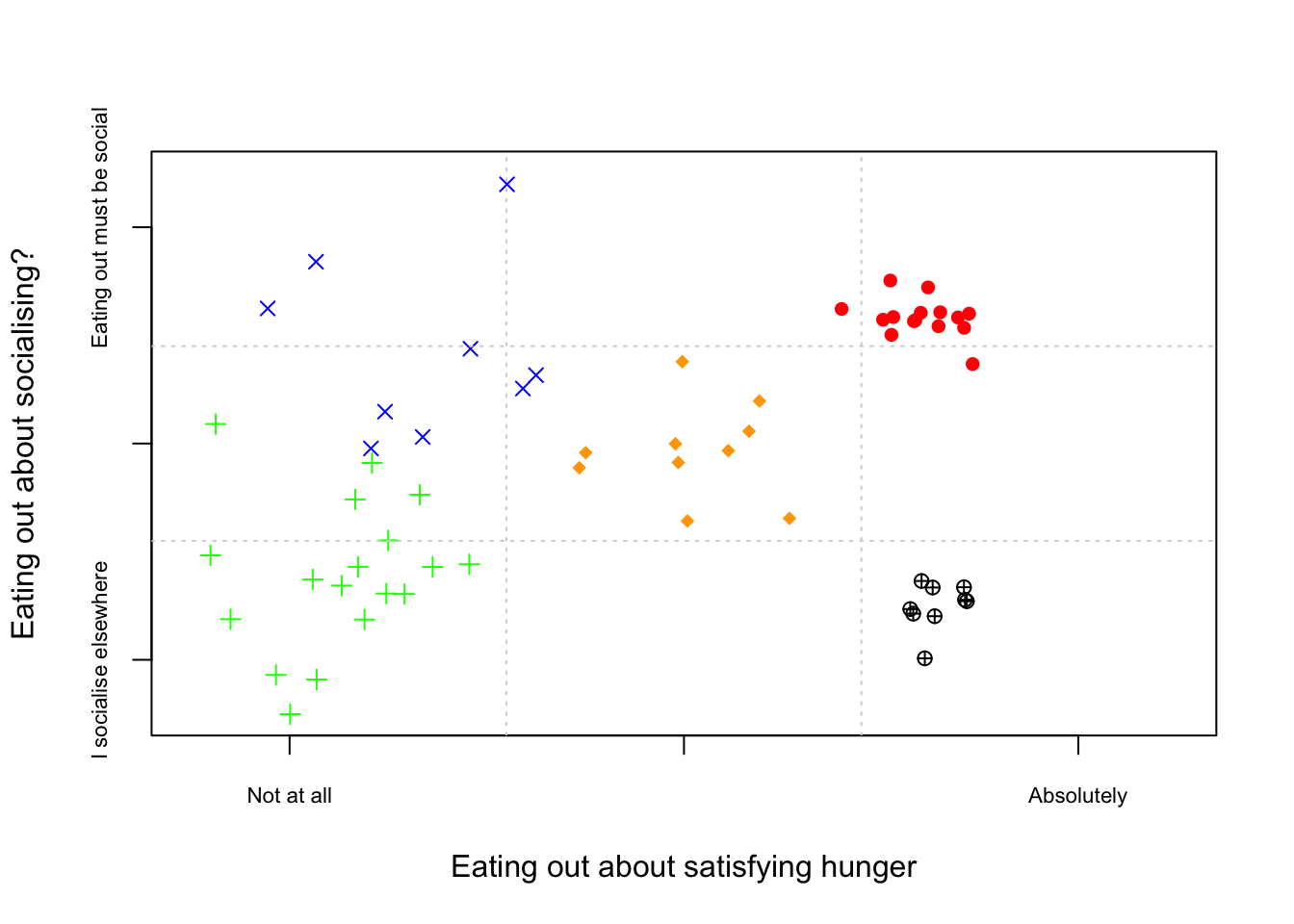
Given the market segment scatter plot in Figure 1, which of the following is the most reasonable conclusion to draw from your segmentation work?
A. Market segment 4 (green, lower left) cannot be be considered because we do not know what motivates them to eat out, we only know what does not motivate them. A similar logic applies to market segment 5 (orange, middle), they seem somewhat motivated by satisfying hunger and somewhat motivated by socialising, but maybe we are missing some understanding about what motivates them. Market segment 2 (red, top right) or market segment 1 (grey, bottom right) are the best to investigate first (but separately) because they are distinct and their motivations are clear.
B. You and your friend, should target market segment 4 (green, lower left) because it is the biggest market segment, and therefore likely to be the most profitable. If further analysis proves it to be unfeasible, then segment 2 (red, top right) is the next largest and best to target.
C. Market segment 3 (blue, top left) is a good segment to target, it would be fun to have them as customers and you would not have to spend much money creating filling food. If further investigation suggests that is not feasible, then market segment 5 (orange, middle) could be a good segment to target because they are also interested in socialising.
D. Market segment 1 (grey, bottom right) and market segment 2 (red, top right) are the best to target and we can treat them as one market segment because they both want to have their hunger satisfied. So long as there are some chairs and tables, we will be fine.
For this task, 6 models from 7 were correct (6 / 7).
2.14.1 anthropic/claude-3.5-haiku (basic)
Answer: A. Expected Answer: A. Is correct: Yes
Explanation: Option A provides the most nuanced and careful analysis of the market segments in the scatter plot. It correctly points out the limitations of market segments 4 and 5, which lack clear motivations. Instead, it suggests focusing on market segments 2 and 1, which have more distinct and clear motivations for eating out. The reasoning shows a methodical approach to market segmentation, emphasizing the importance of understanding customer motivations before targeting a specific segment. The other options either oversimplify the segmentation (B and D) or suggest targeting segments without sufficient justification (C).
2.14.2 anthropic/claude-sonnet-4.5 (basic)
Answer: A. Expected Answer: A. Is correct: Yes
Explanation: Option A is the most reasonable conclusion from a marketing segmentation perspective. It correctly identifies that segments with clear, distinct motivations (segments 1 and 2) should be investigated first. Segment 4 (green, lower left) shows low importance for both dimensions, making it unclear what actually motivates them to eat out - they need further investigation to understand their true drivers. Segment 5 (orange, middle) is moderate on both dimensions, suggesting mixed or unclear motivations. Option B is flawed because targeting the largest segment without understanding their motivations is poor marketing strategy. Option C makes arbitrary assumptions about what would be ‘fun’ without strategic justification. Option D incorrectly suggests combining segments 1 and 2 into one - while both value satisfying hunger, segment 2 also highly values socializing while segment 1 does not, making them distinct segments requiring different marketing approaches.
2.14.3 baidu/ernie-4.5-vl-424b-a47b (basic)
Answer: A. Expected Answer: A. Is correct: Yes
Explanation: The scatter plot shows different market segments based on the importance of satisfying hunger and socialising when dining out. Market segment 4 (green, lower left) shows low importance for both factors, but the explanation in A correctly notes that we lack understanding of what motivates this segment. Similarly, segment 5 (orange, middle) shows moderate importance for both, but we may not fully understand their motivations. Segment 2 (red, top right) and segment 1 (grey, bottom right) are distinct and have clear motivations (high socialising and high hunger satisfaction for segment 2, high hunger satisfaction and low socialising for segment 1), making them better to investigate first. The other options either misinterpret the segment sizes, combine segments inappropriately, or suggest targeting segments without clear motivations.
2.14.4 openai/gpt-5-chat (basic)
Answer: A. Expected Answer: A. Is correct: Yes
Explanation: The scatter plot shows five segments based on two motivations: importance of satisfying hunger and importance of socialising while eating out. Segment 4 (green, lower left) and segment 5 (orange, middle) have unclear or mixed motivations, making them risky to target first. Segment 1 (grey, bottom right) and segment 2 (red, top right) are clearly motivated—Segment 1 wants filling food without socialising, whereas Segment 2 values both socialising and fullness. Therefore, these two distinct, well-defined segments should be investigated first, as described in option A.
2.14.5 qwen/qwen3-vl-235b-a22b-thinking (basic)
Answer: A. Expected Answer: A. Is correct: Yes
Explanation: The scatter plot shows segments based on two key motivations: satisfying hunger (x-axis) and socializing (y-axis). Segment 4 (green, lower left) has low importance for both factors, meaning their motivation for dining out is unclear (not captured by the two main themes). Segment 5 (orange, middle) shows moderate interest in both, but lacks strong clarity. Segments 1 (grey, bottom right) and 2 (red, top right) have clear, distinct motivations: Segment 1 prioritizes hunger satisfaction without socializing, while Segment 2 values both. These segments are actionable because their needs are well-defined, making them the best initial targets. Option A correctly identifies this, whereas other options either prioritize unclear segments (B), rely on subjective reasoning (C), or incorrectly merge distinct segments (D).
2.14.6 x-ai/grok-4 (basic)
Answer: A. Expected Answer: A. Is correct: Yes
Explanation: Option A is the most reasonable because segments 4 and 5 have unclear motivations (low or moderate on both dimensions), making them difficult to target without further understanding. Segments 1 and 2 have clear, distinct motivations (high hunger with low or high socializing), so they are better to investigate separately. Other options ignore unclear needs, overemphasize size, or improperly combine distinct segments.
2.15 Restaurant mini-case (2) (08-03-02-village-restaraunt-case-perceptual-map.Rmd)
Restaurant mini-case (2)
Given the details in the Restaurant mini-case (1), consider the following.
You and your friend have decided to be cautious and to evaluate thoroughly each of the market segments you identified.
You have reviewed your data. Everyone you interviewed was familiar with each of the existing three restaurants. Because you have excellent interview and observation skills, you captured each villager’s evaluations of each of the three restaurants.
In your excellent undergraduate marketing module, you were taught to first design the market offering and then create a perceptual map to see if it is compelling. However, because you have good data you can generate perceptual maps of the villagers’ evaluations of the existing three restaurants without spending more time and money gathering data.
Therefore, you have coded the the interview data for evaluations of the existing restaurants and placed them a perceptual maps (one for each market segment).
The first perceptual map visualises the evaluations of the 15 people that you decided were in market segment 2 (see, Figure 2: “Little Village Restaurants Perceptual Map (Segment 2))”.
What conclusions might you draw from the perceptual map in Figure 2?
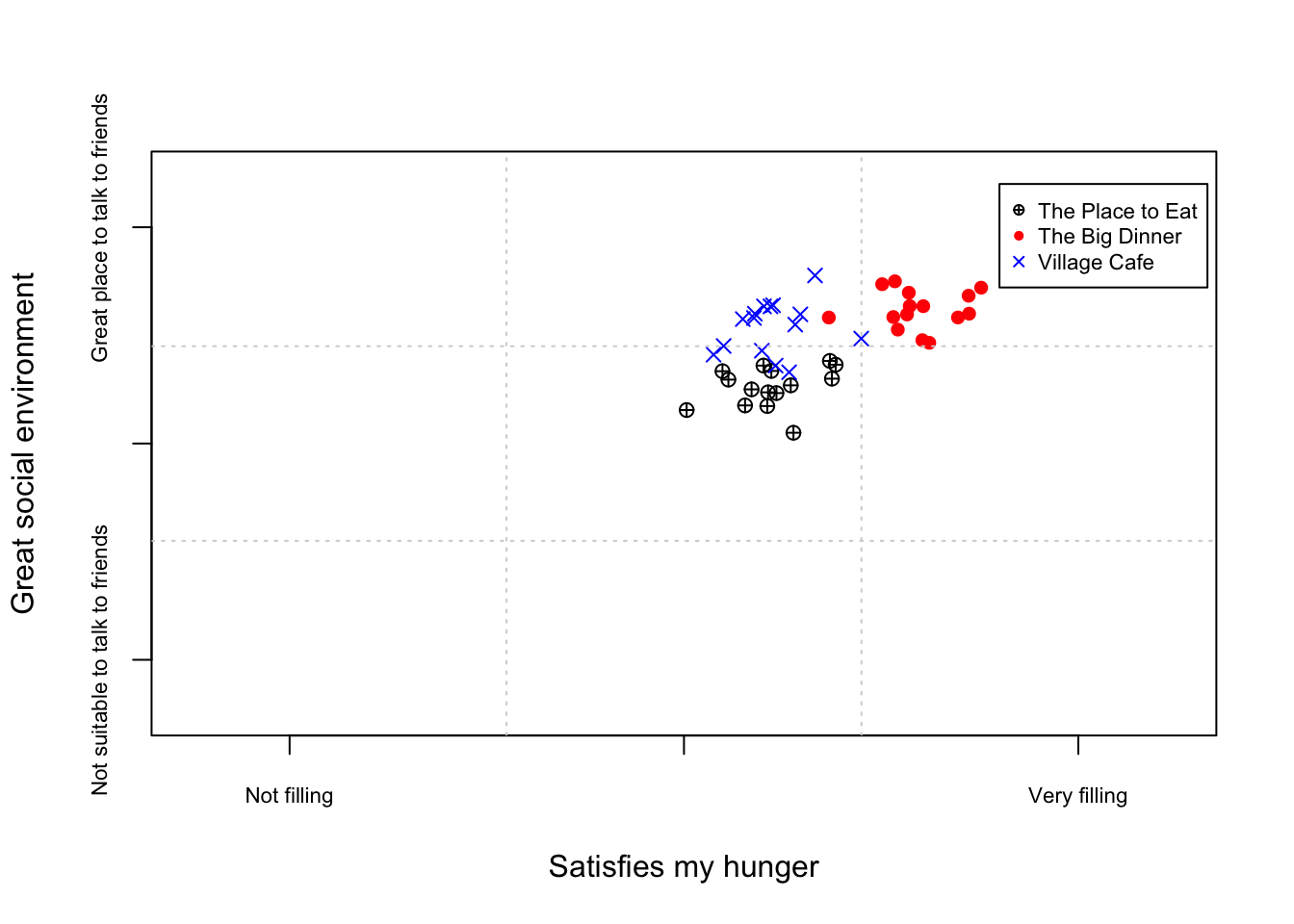
A. You have two options. Option one is to design a value proposition for this market segment (specifying details of the dining room layout and menu options) and test to evaluate how well it is perceived by members of market segment 2. That analysis will help you decide if you can be competitive. Option two is to evaluate the perceptual maps for each of the other market segments to identify if a market segment is poorly served by the existing restaurants. Since you have the data at hand, it makes sense to complete option two first.
B. Each of the three restaurants generally satisfies the two key needs of market segment 2. It might be difficult to create a market offering. But, your friend’s excellent hospitality training and your excellent marketing training, this difficulty can be overcome.
C. It is clear from the information in available that the villagers are very price conscious. We should incorporate our understanding of cost-oriented pricing, competitor-oriented pricing, and value-oriented pricing and undertake a more sophisticated perceptual mapping.
D. The perceptual map underplays the realities. Market segment 1 (grey, bottom right in Figure 1) also want to have their hunger satisfied. We should put them on the perceptual map as well.
For this task, 6 models from 7 were correct (6 / 7).
2.15.1 anthropic/claude-3.5-haiku (basic)
Answer: A. Expected Answer: A. Is correct: Yes
Explanation: Based on the perceptual map for market segment 2, the best course of action is option A. The map shows that while the three existing restaurants are clustered relatively close together, there might still be an opportunity to create a differentiated value proposition. The first step, as suggested in option A, is to design a value proposition for this market segment and test its perception. Additionally, the recommendation to evaluate perceptual maps for other market segments is prudent to ensure a comprehensive market analysis before launching a new restaurant concept. The map indicates that the existing restaurants are somewhat similar in terms of hunger satisfaction and social environment, which suggests there could be room for a more targeted offering.
2.15.2 anthropic/claude-sonnet-4.5 (basic)
Answer: A. Expected Answer: A. Is correct: Yes
Explanation: Looking at the perceptual map for Segment 2, all three existing restaurants (The Place to Eat, The Big Dinner, and Village Cafe) are clustered in the upper right quadrant, indicating they all score relatively high on both dimensions: ‘Satisfies my hunger’ (x-axis) and ‘Great place to talk to friends’ (y-axis). This means the existing restaurants are already serving this segment’s needs reasonably well, making it potentially difficult to differentiate. Option A correctly identifies that: (1) you could design and test a value proposition for this segment, but (2) it makes more strategic sense to first examine the perceptual maps for other segments to see if there’s a segment that is poorly served by existing restaurants - which would represent a better market opportunity. Option B incorrectly suggests the restaurants satisfy the needs but downplays the competitive challenge. Option C introduces pricing concerns not evident from this perceptual map. Option D misunderstands the purpose of segment-specific perceptual maps - each segment has its own map based on their unique evaluations.
2.15.3 baidu/ernie-4.5-vl-424b-a47b (basic)
Answer: A. Expected Answer: A. Is correct: Yes
Explanation: The perceptual map shows the evaluations of the existing three restaurants by market segment 2 along two dimensions: ‘Satisfies my hunger’ and ‘Great social environment’. The existing restaurants are positioned in a way that suggests they are meeting the needs of this segment to some extent. However, the question asks for conclusions that can be drawn from the perceptual map. Option A suggests a logical next step: designing a value proposition for this segment and testing it, or evaluating other segments to see if they are underserved. This is a reasonable approach given the data at hand. Option B is incorrect because the map does not clearly show that all three restaurants satisfy the two key needs; instead, it shows a spread of evaluations. Option C is not supported by the map, as there is no direct indication of price consciousness. Option D is irrelevant because the question specifically focuses on segment 2, and bringing in segment 1 would not help in drawing conclusions about segment 2.
2.15.4 openai/gpt-5-chat (basic)
Answer: A. Expected Answer: A. Is correct: Yes
Explanation: The perceptual map shows that the three existing restaurants all cluster closely together and generally serve segment 2 well across the two key dimensions—‘satisfies my hunger’ and ‘great social environment.’ There is little perceptual space indicating an unmet need or clear market gap. Therefore, the logical next step is not immediately to design a new offering for this segment but rather to evaluate the perceptual maps of the other market segments to identify where unmet needs may exist. Option A appropriately recommends this course of action before investing further resources.
2.15.5 qwen/qwen3-vl-235b-a22b-thinking (basic)
Answer: A. Expected Answer: A. Is correct: Yes
Explanation: The perceptual map for Segment 2 shows that existing restaurants are clustered in similar positions on the axes (hunger satisfaction and social environment), suggesting potential overlap in how they meet Segment 2’s needs. Option A correctly advises evaluating other market segments first, as the data is already available, to identify underserved segments rather than immediately designing a new offering for Segment 2. Options B, C, and D are incorrect: B assumes all needs are satisfied without evidence of a gap, C introduces price (not shown in the map), and D misapplies Segment 1’s relevance to Segment 2’s map.
2.15.6 x-ai/grok-4 (basic)
Answer: A. Expected Answer: A. Is correct: Yes
Explanation: The perceptual map for segment 2 shows the existing restaurants positioned variably on hunger satisfaction and social environment, suggesting potential gaps but not clearly indicating if the segment is poorly served. Option A logically concludes that, with data available, evaluating other segments for underserved opportunities should precede designing a proposition for this segment.